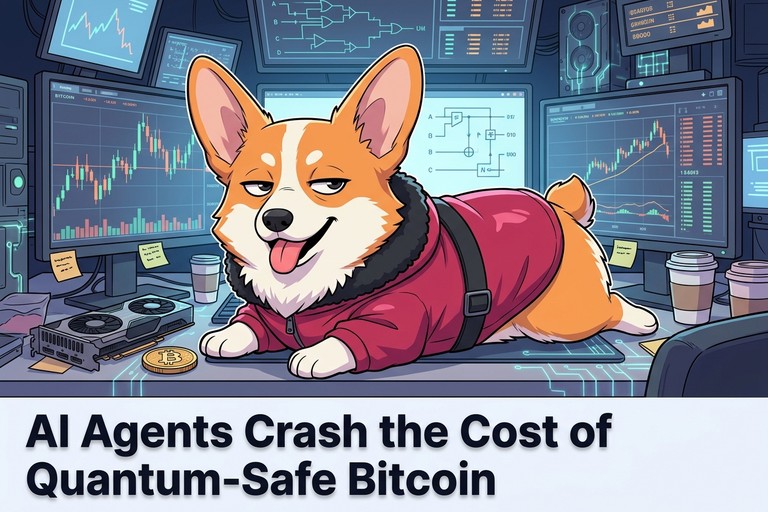
AI Agents Are Quietly Making Quantum-Safe Bitcoin Cheap
StarkWare's Quantum-Safe Bitcoin Optimization Challenge has turned into an AI leaderboard. In one week, the estimated cost of building a quantum-resistant Bitcoin transaction fell from about $320 to roughly $67 in GPU compute, according to Decrypt.
- The leading records were held by developers running AI models, including Anthropic's Opus 5 and Fable 5.1, with OpenAI's GPT-6 Astra, Grok 4.6, and Kimi close behind.
- The first quantum-safe Bitcoin transaction on mainnet took roughly 3,100 GPU-hours and cost around $320 to construct.
- The savings come from optimizing a brute-force search that runs on a user's own GPU before anything hits the chain — roughly one in 70 trillion hash outputs fits the required shape.
StarkWare itself cautions the $67 is an estimate, not a price, and that none of this makes Bitcoin quantum-safe on its own. The team still favors a soft fork long-term. So file this under "impressive benchmark," not "problem solved."
Wall Street Wants AI Agents to Do the Banking
BlackRock — the world's largest asset manager — says AI agents will drive new demand for digital assets, and specifically stablecoins, per bitcoinke.io and CryptoRank. Pantera's founder put it more bluntly: "They can't open bank accounts," so agents will lean on crypto rails instead (Yellow.com).
- A separate Cryptonews.net report claims Grok is out-trading ChatGPT 40 to 1 among Coinbase AI agents. Treat that ratio with the skepticism it deserves — headline math, not audited performance.
- Another Cryptonews.net piece says AI agents are opting for Ripple USD over XRP.
The pitch is consistent: autonomous software needs programmable money because it can't fill out a KYC form. The catch is that "AI agents will drive demand" is currently a thesis with a slide deck, not a revenue line. BlackRock saying it doesn't make it happen on schedule.
Compute, GPUs, and the Infrastructure Bets Underneath
- Delos Data, which builds network chips and software to connect AI chips inside data centers, raised $100 million from Matrix, Playground, Socratic Partners and others (Techmeme/Reuters).
- Google made free 1080p AI video generation available to anyone via Google Vids, running on Gemini Omni 1.1 Flash, with SynthID watermarks on every clip — the same day OpenAI's Sora API reportedly went dark (Decrypt).
- A EurekAlert paper proposes a two-way trust framework for AI agents and blockchain, which is the unglamorous plumbing this whole sector actually needs.
Everyone wants to talk about agents trading tokens. Almost nobody wants to talk about trust, identity, and settlement rails. That's where the real work — and the real risk — lives.
Meanwhile, in the Rest of Crypto
- U.S. spot Bitcoin ETFs logged a seven-day inflow streak worth about $2.98 billion, flipping 2026 net flows positive at roughly $886.8 million through Thursday, per Decrypt and Farside. The Block puts the weekly haul at $2.4 billion, the largest since October 2025.
- The Senate's Clarity Act failure pushed rulemaking to regulators: the SEC floated a tokenized-stock innovation exemption, the CFTC issued no-action relief, and the Fed proposed stablecoin reserve rules (Decrypt).
- A Bitget hacker moved $83 million in stolen XRP that Ripple cannot freeze, while Circle and Tether froze about $320,000 in connected stablecoins (CoinDesk).
- Zcash holders voted overwhelmingly for 25-second blocks while keeping Bitcoin-style halvings in the NU7 upgrade (Unchained).
Crypto spent two years chanting "clarity" at Congress. Congress said no, and the agencies said "fine, we'll do it ourselves" — which is faster today and easier to unwind tomorrow. Enjoy the vibes while they last.
Closing Take
The most interesting thing in crypto right now isn't a token — it's AI models competing to make cryptography cheaper and Wall Street rehearsing a world where software, not people, holds the accounts. Both stories are early, both are oversold, and both are worth watching closely. The quantum-safe cost curve is real and measurable; the AI-agent stablecoin demand story is still a prediction. Side-eye accordingly.
Not financial advice. Do your own research.