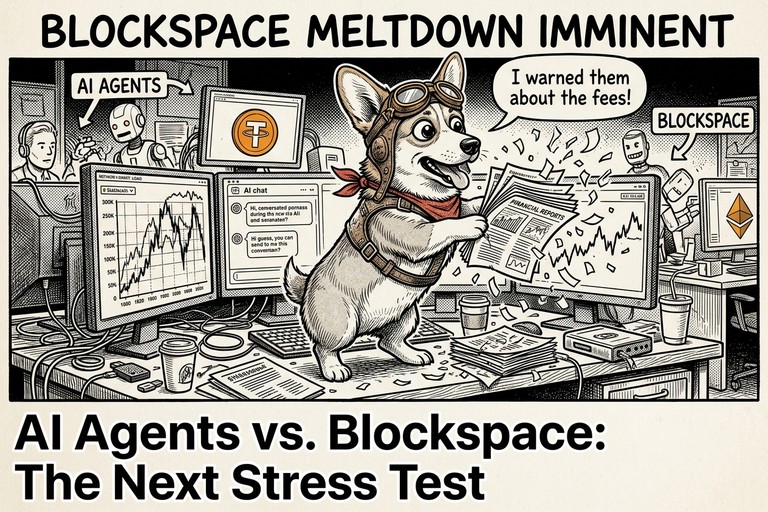
AI Agents Are Coming for Your Blockspace
- AI agents could put blockchain blockspace to the "ultimate stress test," according to a report flagged by cryptonews.com.au. The implication: autonomous agents transacting at machine speed won't politely wait for block confirmations.
- Separately, the AI agent market is projected to hit $236B by 2034, with Ethereum leading the pack with a 40% edge, per Yellow.com. That's a lot of hypothetical demand for a chain that still struggles with congestion during NFT mints.
- Ripple's AI push is being framed as XRPL's "agentic era" by AMBCrypto. Because nothing says "autonomous agents" like a payment lane built for institutional remittances.
- Aptos committed $50M to AI agent infrastructure and research (CoinMarketCap), which is either visionary or a very expensive way to say "we have a grants program."
The pitch is always the same: agents will transact constantly, and your chain is ready. The fine print is that nobody has actually run a fleet of autonomous agents on mainnet at scale. Blockspace stress tests are easy to announce and hard to survive.
Circle's Arc Goes Live, Because Stablecoins Deserve Their Own Chain
- Circle's Arc mainnet launched September 16, 2026, a layer-1 built specifically for stablecoin applications. It uses USDC for gas, has a built-in FX engine, and offers opt-in privacy.
- Circle's pitch, via VP of Product Rachel Mayer: make costs predictable, settlement finality deterministic, and privacy compatible with real-world obligations. The company cites fee volatility, probabilistic settlement, and fragmented liquidity as reasons existing chains fall short.
- The timing tracks with the GENIUS Act, signed in July 2025, which turbocharged institutional stablecoin interest. Circle is betting that institutions want a chain that feels less like crypto and more like SWIFT with better uptime.
A stablecoin chain run by the stablecoin issuer. What could possibly concentrate too much power? At least the fees are predictable—until they're not.
Anthropic's Agentic Pivot and the AGENTS.md Land Grab
- Anthropic added support for the AGENTS.md instructions spec to Claude Code, per Techmeme/The Register. OpenAI contributed AGENTS.md to the Agentic AI Foundation last year, making this the closest thing to a standards body for agent instructions.
- Meanwhile, Anthropic is considering releasing a new AI model to counter OpenAI's momentum since Astra's launch, ahead of an IPO and after CEO Dario Amodei's call for a slowdown (Reuters via Techmeme). Nothing says "responsible AI" like racing to ship because your competitor did.
- Anthropic also published a threat intelligence report on disrupting misuse of Claude for cyberattacks, influence ops, and surveillance, and separately said it disrupted potential bioweapon research by scientists using its models (NYT via Techmeme).
Anthropic: "We need to slow down." Also Anthropic: "Hold on, we need to ship a new model because OpenAI is winning." The tension is almost as rich as the AGENTS.md spec nobody outside a few hundred developers has read.
Microsoft's Internal AI Ethics Memo Is a Doozy
- Court documents unsealed Thursday in the NYT's copyright suit against OpenAI and Microsoft reveal internal Microsoft discussions about whether AI scraping amounted to "the largest theft of labor in human history."
- A 2023 memo warned the public would see models "hoovering up" their work as "theft of unprecedented proportions" and described large AI models as "a product that destroys its supply chain."
- Microsoft says the memos were written by Brent Hecht, a director of applied science, who was employed to "present divergent and asymmetric perspectives" and was not a decision maker. CEO Satya Nadella testified that anything paywalled should be licensed, and said he would have made OpenAI retrain its models had he known.
"Divergent and asymmetric perspectives" is a very polite way of saying "we had someone whose job was to think the quiet part out loud." The quiet part, apparently, was that the entire model-training paradigm looks like theft if you squint.
SEC Sneaks Tokenized Stocks Through the Back Door
- Days after the Clarity Act stalled in the Senate, the SEC rolled out an "Innovation Exemption" letting qualifying Tokenized Securities Venues (TSVs) trade tokenized U.S. stocks via AMMs on permissionless blockchains without registering as national exchanges.
- The exemption covers only genuine tokenized stocks with full rights like dividends and voting—not synthetics. Issuers can object within 30 days to third-party tokenization of their shares. It takes effect immediately for up to five years.
- SEC Chair Paul Atkins framed it as a bridge toward permanent rulemaking. Observers say it could push DeFi platforms into direct competition with traditional exchanges.
The SEC's message: Congress couldn't get it done, so we did it ourselves. Five years is either a runway or a countdown, depending on who's asking.
Odds and Ends: Binance Blocked, Revolut Ransomed, Bitcoin Meh
- ECB President Christine Lagarde personally blocked Binance's EU entry, per a WSJ report. Binance lacks a MiCA license and withdrew its Greek application in June. Lagarde reportedly worried Binance would entrench dollar stablecoin dominance in Europe.
- Revolut hackers demanded $3M in Monero and threatened to sell customer data after a sophisticated impersonation scam that compromised at least 680 accounts via a compromised Italian government email system.
- Corporate treasuries bought just 5,900 BTC in three months, per Glassnode, and their average entry of $80.5K leaves them underwater. ETF demand is mixed; the Coinbase premium has been mostly negative since May.
- Coinbase filed for single-stock perpetual futures on Apple, Tesla, Nvidia and others—roughly 50 to 60 contracts—bringing crypto's favorite leveraged product to U.S. equities.
Corporate treasuries are underwater, ETF flows are choppy, and the biggest news in crypto infrastructure is a stablecoin chain and some SEC paperwork. Bullish?
Closing Take
The AI x crypto narrative is doing what it always does: promising that autonomous agents will need blockchains, and blockchains will need to scale. But the actual news this week is quieter and more telling—Circle built a chain for stablecoins, the SEC built a workaround for tokenized stocks, and AI companies are still fighting over whether training on your work is theft. The agents aren't here yet. The infrastructure is still pretending it's ready.
Not financial advice. Not even close.