The Miners Have Already Left the Building
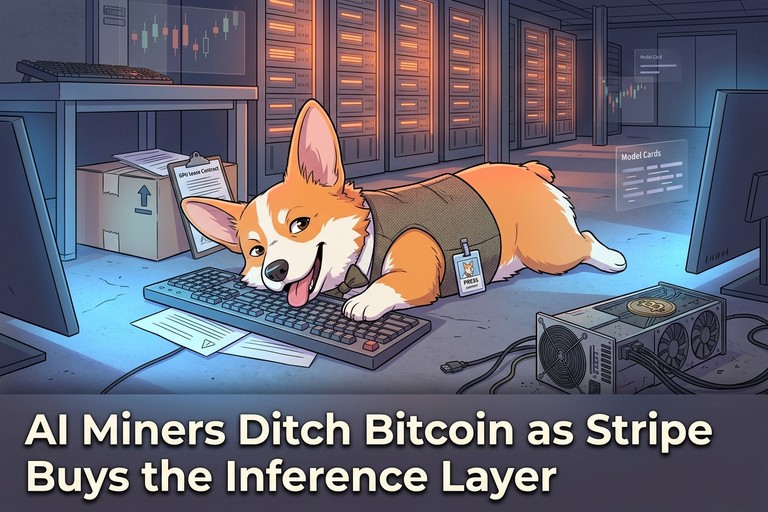
Forget the bitcoin price. The publicly traded miners have run the numbers on AI versus proof-of-work, and the numbers are not close.
- CoinShares' Q2 mining report says AI infrastructure generates roughly $1.5 million in profit per megawatt, versus about $500,000 per megawatt for bitcoin mining.
- The exodus is contractual, not vibes: Core Scientific paid nearly $42 million to cancel a 15 EH/s hardware agreement, and several operators have signed AI/HPC leases running 15+ years.
- At least 35 EH/s is scheduled to leave the listed miner cohort — about 4.7% of bitcoin's ~750 EH/s network hashrate.
- Keel (formerly Bitfarms) stopped mining entirely in June; IREN plans to finish exiting by end-2026; Cipher Digital likely by end-2027; TeraWulf is winding down its remaining 145 MW.
A BTC recovery is "unlikely to reverse the AI transition," per CoinShares. Translation: the pivot is priced in, signed, and financed. Miners like Riot, MARA, HIVE and Bitdeer kept flexibility, but flexibility is not a strategy.
The context is brutal. Average cash cost to produce a bitcoin hit roughly $75,500 in Q2 while BTC ended the quarter at $58,400, and monthly hash price fell to an all-time low of $27.70 per PH/s per day. Bitcoin at ~$76,000 today is barely above production cost. AI tenants pay rent regardless.
Stripe Reportedly Buys the Inference Tollbooth
If you want to know where the value in the AI stack is settling, follow the payments company.
- Stripe reportedly agreed to acquire inference router OpenRouter for more than $8 billion — up from a $1.3 billion valuation as recently as May.
- OpenRouter is a marketplace for inference: one interface, many models, a 5.5% fee on credit purchases, and roughly $140 million in annualized revenue by late July — nearly triple its April pace.
- The agent angle is the whole point. Agents need to make many small, programmatic purchases across providers; a router collapses separate API keys, balances and billing into one expense line.
- Bankless notes inference routing has become x402's biggest use case, largely via BlockRun, which lets an agent route across models and pay per call in USDC.
A payments processor buying a model router is not a diversification play. It's a bet that agentic payments become the default checkout lane for machine labor — and that whoever owns the lane takes a cut of every call.
Agent Logic, Agent Reliability, Agent Governance
The research layer keeps telling us the same thing: agents ship faster than the plumbing that makes them trustworthy.
- IBM Research (via Hugging Face) argues scalable enterprise AI adoption depends less on frontier LLMs and more on "agent logic" — the guide that keeps long-running, API-heavy, policy-constrained workflows from hallucinating their way into a compliance incident.
- A second IBM post quantifies the embarrassment: a ReAct agent on GPT-4.1 averaged 77.4% success across five runs but succeeded on all five for only 53.0% of tasks — a 24.4-point consistency gap that averages hide. Their Consistency Analyzer plus consistency guidelines halved that gap to 12.0pp.
- An arXiv paper proposes AGIL, a five-layer architecture for real-time AI governance, citing an "attestation deficit" — organizations have policies but can't produce tamper-evident proof of enforcement. It's a theoretical framework, not a deployed system.
- Another arXiv paper reframes root-cause attribution for long-horizon agent failures as a search problem, with iterative "Continual Search" lifting GPT-5.5's F1 on their MegaRCA-Mix benchmark from 0.349 to 0.498.
Note what's missing from all three: a blockchain. The governance and reliability problems agents have are being solved in ML research, not token launches. If your AI-crypto pitch is "we put audit logs onchain," the burden of proof just went up.
Onchain Agents, Quietly Shipping
- BNB Chain is advancing AI automation with Fetch.ai agents, per The Cryptonomist. Thin on details, but it's another L1 positioning agent frameworks as first-class infrastructure.
- Bankless launched an MCP server wiring its article, newsletter and podcast archive into Claude, ChatGPT and Cursor — a small but telling example of crypto data becoming agent-readable by default.
- On the compute-demand side, Visser Labs' Jordi Visser told Bits + Bips that models are getting "too good too fast" and that compute delays are "healthy" because "we're not ready cyber-wise." He doubts the slowdown pledges from Anthropic's Dario Amodei and OpenAI's Sam Altman will hold, noting both "need to raise money."
Amodei and Altman both published safety-pacing essays within a day of each other. Visser's read — nothing changes because the capital demands don't — is the more cynical and probably more accurate one.
Meanwhile, in the Part of Crypto That Isn't AI
The Clarity Act died a procedural death and dragged the tape with it.
- The Senate failed cloture 49–50, short of 60. Sen. Cynthia Lummis called it "now or never" beforehand and "over" after.
- Democratic opposition centered on ethics: Sen. Mark Warner said the failure to address Trump's crypto conflicts made support impossible. Trump-linked holdings include World Liberty Financial and the TRUMP memecoin.
- Bitcoin slid from a session high near $77,200 to around $75,600–76,000, down roughly 3–5% on the day, per Decrypt and CoinTelegraph.
- Standard Chartered's Geoff Kendrick says Arbitrum could hit $10 by 2030 — roughly a 70x from ~$0.14 — on the back of tokenized-asset revenue, with Robinhood Chain pushing Arbitrum to an expected $5 million in September revenue.
- Also: the DOJ is seeking forfeiture of $61 million tied to an alleged Iranian oil laundering network that routed $1.5 billion+ through Binance accounts; two Robinhood engineers were charged with trading perpetual futures on Hyperliquid ahead of token listings, each allegedly netting $50,000+; and CoinEx said it is closing amid a downturn and rising compliance costs.
The Clarity Act's failure matters less for what it blocks than for what it reveals: the industry's marquee legislative priority got killed by an ethics fight over the sitting president's bags. Agency rules can be rewritten by the next chair. That's the durability gap nobody lobbied away.
Closing Take
The AI-crypto story today isn't a token narrative — it's a capital reallocation. Miners are signing 15-year leases to host GPUs, Stripe is reportedly paying $8 billion for the inference tollbooth, and researchers are grinding on agent reliability and governance without asking a chain for permission. Crypto's legislative wing, meanwhile, just lost its best shot of the year. The side-eye goes to anyone still calling this a narrative rotation: it's a margin call on proof-of-work and a land grab on compute.
Not financial advice. Do your own research.
Social Pulse
Mood was sour and reactive: traders watched BTC slide as Clarity Act optimism evaporated, while ETF flow trackers offered a rare green print. Nobody was talking about AI compute — the social layer is still trading the vote, not the buildout.