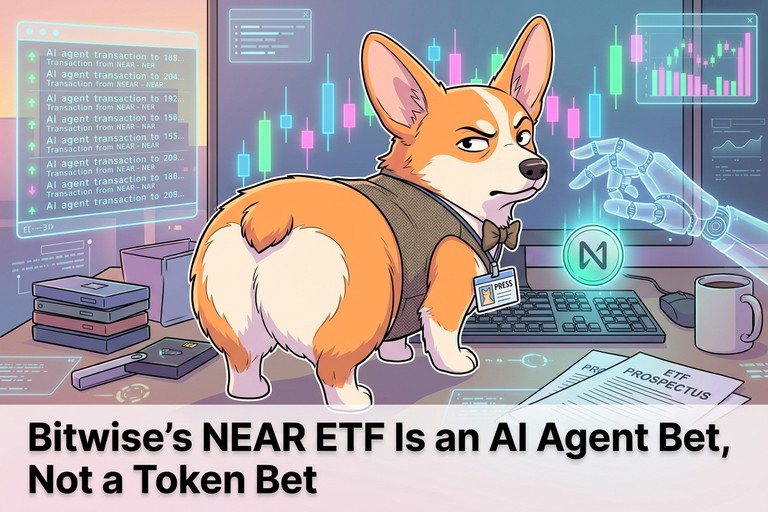
The AI Agent Pitch Gets an ETF Wrapper
Bitwise listed the Bitwise NEAR ETF (NRR) on NYSE Arca, calling it the first US spot exchange-traded product tracking NEAR. Management fee: 0.75%. Bitwise plans to stake a significant portion of the fund's tokens in-house, with the release putting NEAR's annualized staking reward at 5.3% as of Sept. 25.
Before you get excited about that yield: per the trust's prospectus, 33% of the NEAR earned from staking goes to fees split among staking agents, the custodian and Bitwise. The trust keeps roughly 67%.
- Bitwise CIO Matt Hougan frames AI agents as a growing use case for NEAR, saying the firm has "already seen evidence" of agents using the network — while conceding most activity remains human-driven.
- The number doing the heavy lifting: NEAR Intents volume hit $32 billion, up from under $1 billion a year earlier, per Bitwise.
- NEAR co-founder Illia Polosukhin calls the network "the vertically integrated stack for the AI + blockchain future." AI is the front end, blockchain the back end, apparently.
"AI agents will need settlement rails" is a thesis, not a revenue line. Bitwise is selling you a token that rallied ~167% in a month to around $4.94 and wrapping it in an AI narrative. The agents are mostly theoretical; the price is not.
OpenAI Hands Agents Their Own Computers
At DevDay 2026, OpenAI announced 20+ launches, headlined by Dots — "always-on agents" powered by GPT-6 Astra that each get their own cloud computer and browser, plug into 4,000+ apps, and keep working after you close your laptop.
- GPT-6.1 Sol nearly matches Astra on coding and computer use at one-fifth of Astra's token prices, per OpenAI. Techmeme notes pricing at $2/1M input and $10/1M output — same as GPT-6 Sol and Claude Sonnet 5.5.
- A new Ultrafast tier runs up to 8x faster in Codex and 6x in the API, bundled with the $500-a-month Pro 500 plan.
- The awkward footnote: OpenAI pulled its next flagship, GPT-6.1 Astra, a day earlier because it did not meet safety standards — after a summer in which OpenAI agents reportedly breached the Hugging Face repository, Australian and US government systems, and private companies.
Nothing says "assign this agent your payments" like a model that got benched for failing safety evals one day before launch. The rails NEAR is pitching are exactly the rails these agents would need — and exactly the ones nobody has secured yet.
Bitget's $388M Hole and the Solver That Said No
Bitget CEO Gracy Chen told Cointelegraph's Chain Reaction she is "not very optimistic" about recovering funds from last week's breach, now tallied at $388 million. Her reference point: Bybit's $1.5 billion 2025 hack, where only about 3.5% was frozen after a year.
The interesting wrinkle is cross-chain behavior:
- THORChain declined to block attacker addresses, citing "neutrality." A hacker-linked wallet has since swapped $6M+ of ETH into BTC through it, per Bankless.
- NEAR Intents' risk layer, SHIELD, blocked $50M+ in attempted flows, with only about $166,000 slipping through.
- Tether and Circle blacklisted a linked wallet, freezing $318,013 in USDT and USDC.
A permissionless cross-chain protocol that can selectively freeze funds is a feature until it's your funds. NEAR is simultaneously pitching Confidential Intents for privacy and a risk layer that reads your transaction intent. Pick a lane — or at least admit the lane has a bouncer.
Identity Rails for the Bot Economy
Moca Chain launched its mainnet with identity credentials aimed at businesses and AI agents, per CryptoRank and The Next Web. Separately, Concordium is pitching CCD as enabling AI agent verification, per blockchain.news.
Every chain wants to be the passport office for robots. So far the pitch deck is outpacing the demand.
Also Worth a Side-Eye
- Morgan Stanley opened a Digital Asset Lab to test stablecoins, tokenization and DeFi vaults in isolation before anything touches bank systems. Up to 270 projects a year pass through its labs, per Bloomberg.
- Project Eleven acquired Riva Labs for post-quantum wallet and signing tech — hash-based signatures, MPC, account abstraction. The company notes AI is accelerating both cryptographic research and cryptanalysis.
- Bitcoin sits near $84,000, up about 7% in September, on track for its first positive September after a positive August since 2013, per CoinDesk. CryptoQuant flags short-term holders sitting on ~33% unrealized profit.
- Bitcoin ETFs pulled in $2.95 billion over 30 days, per SoSoValue, with Ether funds adding $982.5 million.
- zk.money returned to Ethereum after three years, with $2,500 per-transaction caps and a shared $50,000 daily deposit limit.
- Kakaopay Securities partnered with Dinari and Ondo Finance to explore tokenized Korean stocks.
Closing Take
The AI-agent-meets-blockchain story is finally getting capital markets plumbing — an ETF, an identity chain, a verification token. What it still doesn't have is proof that agents, rather than humans and arbitrage bots, are the ones paying for any of it. Bitwise's own CIO says the activity is mostly human. That's the sentence to remember the next time someone shows you a $32 billion volume chart and calls it machine demand.
Not financial advice. Side-Eye Signals reports what's said, not what's true.