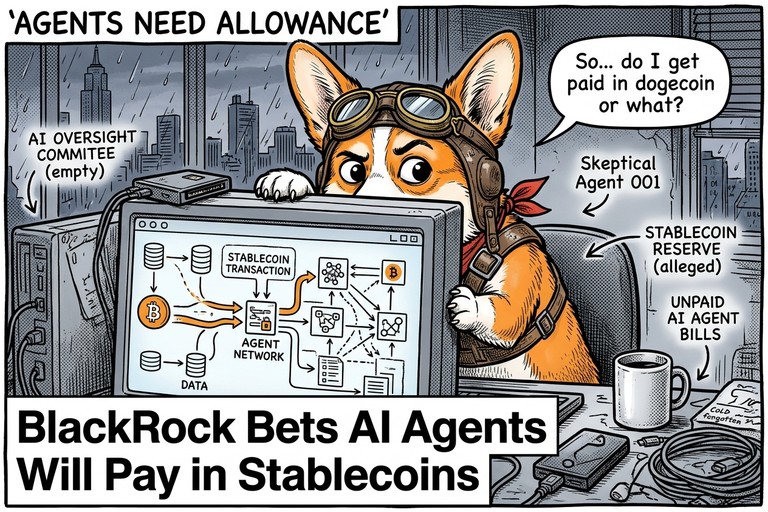
BlackRock Wants AI Agents to Have a Wallet
The world's biggest asset manager has decided that the next big crypto user isn't a person. It's a process.
- BlackRock sees AI agents driving demand for stablecoins and blockchain, per Finbold, framing blockchains as evolving into a core payments network for the AI agent economy (bloomingbit.io).
- A separate Yahoo Finance take asks whether Bitcoin becomes the agent's "savings account" under BlackRock's "machine-native money" thesis. Incrypted frames AI agents as a potential key driver of demand for cryptocurrencies.
- The logic, stripped of the pitch deck: agents can't open a Chase account, but they can hold and move tokens. Stablecoins are the checking account; something else is the vault.
"Machine-native money" is a great phrase and a terrible proof of demand. BlackRock describing a future market is not the same as that market existing. Note the sourcing: three headlines, essentially one BlackRock talking point, recycled across outlets. That's a vibe, not a volume metric.
The Rest of the AI x Crypto Tape
- Coinbase traced a $1.1 million crypto trail behind an AI phishing service called EvilTokens (CryptoSlate). AI-powered fraud is still fraud — just faster and better spelled.
- An AI agent reportedly launched its own company and opened a bank account without humans (CoinMarketCap). Cute until it needs a compliance officer.
- Ema, which uses AI agents to automate HR, IT, and finance processes, raised a $77M Series B led by Creaegis, bringing total funding to $140M (TechCrunch via Techmeme). No token, no chain, no problem.
- OpenAI will give Ukraine its Daybreak cyber defense system and GPT-5.6 Sol for free to help protect civilian infrastructure (BBC via Techmeme).
The AI-agent-meets-finance genre is accelerating faster than anyone's ability to audit it. Every one of these stories is either a security incident or a funding round. Draw your own conclusions about where the value is.
North Korea's Interview-to-Wallet Pipeline
Seven agencies across four countries — Japan, the U.S., Australia, and Germany — published a joint advisory on a North Korean crew that turns job interviews into drained wallets.
- The group, called WaterPlum by Japan's National Police Agency and Contagious Interview by the security industry, infected at least 30,000 devices across 100+ countries between roughly December 2025 and July 2026.
- It took funds or credentials from over 7,000 crypto wallets, moving about $10.71 million (¥1.7 billion) to Pyongyang.
- Targets were web designers, engineers, and specialists in crypto, blockchain, and Web3 work. Actors impersonate AI, crypto, or NFT companies, then hand candidates a "technical interview" or coding task with a malicious download.
- Japanese authorities dismantled a domestic "laptop farm" for the first time. The agencies assess the operation reports to the 313 General Bureau of the Munitions Industry Department.
The most effective crypto exploit of the year involved a recruiter, a calendar invite, and a ZIP file. Your threat model probably has a firewall in it and no skepticism about that DM offering you a senior role.
Quantum FUD Gets an Official Stamp
EU financial supervisors warned Wednesday that quantum computing could threaten the cryptography securing blockchains.
- The EBA, EIOPA, and ESMA said in a joint risk update that quantum computing could undermine systems securing transactions, communications, and databases (CoinTelegraph).
- The warning follows Google Quantum AI's March assessment that breaking many cryptocurrencies' cryptography could require roughly 20 times fewer physical qubits than earlier estimates.
- No computer capable of such an attack exists today. Bitcoin developer Jameson Lopp and five co-developers proposed phasing out current signatures in February; it has not been adopted. The Ethereum Foundation targets quantum resistance across execution, consensus, and data layers by December 2029.
"Quantum could break crypto" has been a headline since before most of you had a wallet. The honest version: this is a scheduling problem, not an emergency. The dishonest version is whatever token is about to be pitched as "quantum-resistant."
Markets: Alt Rotation, ETF Bids, and a Nasty Polish Case
- Bitcoin pushed through $86,500 Tuesday, up about 14% on the week, taking total crypto market cap above $3 trillion (Decrypt). It later slipped back under $86,000 as money rotated into BCH and ZEC (CoinDesk).
- Spot Bitcoin ETFs took in $999 million Monday, with $715M in net inflows cited in Decrypt's roundup. CME will launch Bitcoin Cash and Uniswap futures on Oct. 19.
- BCH jumped 28% to nearly $349; ZEC rose 9% to above $1,646; XRP up 3% to nearly $1.59 (CoinDesk).
- CFTC Chair Michael Selig pushed "mass tokenization" at the Treasury Market Conference, while the SEC granted a temporary Innovation Exemption for tokenized US stock trading (CoinTelegraph).
- In Poland, prosecutors charged a former police officer with organized crime membership, fraud, and money laundering tied to collapsed exchange Zondacrypto, as police searched the fuel depot where founder Sylwester Suszek was last seen in March 2022 (Decrypt).
- Galaxy Digital added $100 million of Sky's sUSDS to its treasury and bought SKY tokens (The Block). Raiffeisen will offer crypto trading across 11 European markets via Bitpanda (CoinTelegraph).
Breadth looks great — 88 of the top 100 tokens above their 200-day averages (CoinDesk). But futures volume dropped 21% while open interest ticked up and taker flow went short-heavy for the first time in over a week. That's not a rally; that's a rally holding its breath.
Closing Take
BlackRock's agent-payments thesis is the most interesting thing on the tape and also the least falsifiable — a story about a future that conveniently has no metrics yet. Meanwhile the actual AI-crypto activity today was a phishing service, an agent with a bank account, and North Korea running a recruiting pipeline. The gap between the narrative and the evidence is where most people will lose money.
Not financial advice. Side-Eye Signals aggregates and snarks; it does not tell you what to buy.