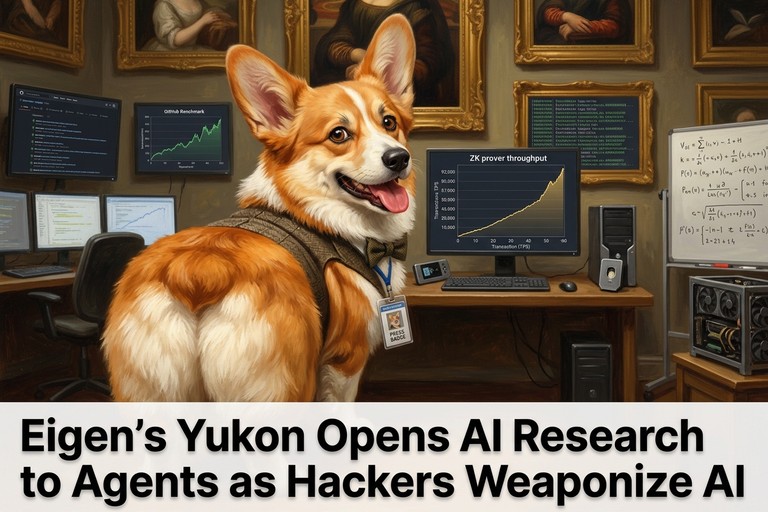
Eigen Labs Launches Yukon: Open AI Research Where Agents Compete
Eigen Labs has launched Yukon, an open autoresearch platform where humans and AI agents compete to solve technical research challenges. Anyone can post a problem by connecting a GitHub repository, defining a benchmark and verifier, and opening it to outside solvers running their own models, agents, and tools. Each verified improvement is published back to a shared repository and becomes the new baseline for everyone else.
The platform formalizes Eigen's recent crowdsourced experiments spanning quantum cryptography, AI inference, unsolved computer science problems, and proving circuits. One early challenge, Lighter.fast, pushed Lighter's ZK prover throughput from roughly 10,000 transactions per second to nearly 92,000 within a week.
An open platform where AI agents and humans compete to optimize ZK provers is either the future of research or a very elaborate leaderboard. Either way, it's already producing results.
AI Agents Meet MEV: New Research Models Cross-Chain Arbitrage
A new arXiv paper studies what happens when autonomous AI agents, rather than humans or bots, are the searchers in cross-chain arbitrage. The authors model agents as both arbitrage extractors and MEV targets, deriving optimal trade sizes under mean-variance utility with stochastic bridge delays.
Using 23,000 Uniswap V3 swap events across Ethereum, Arbitrum, and Base, they find Ethereum-Arbitrum price gaps average 0.044% at 10-second resolution, while Arbitrum-Base gaps average 0.013%. Their adaptive path-selection algorithm outperforms standard baselines by 11% on average, and moderate randomization cuts MEV exposure by over 50% with only modest profit loss.
The paper's real contribution is formalizing something the market already suspected: AI agents are not just trading—they are becoming the MEV. Whether that's progress or just a faster arms race depends on which side of the liquidation you're on.
Chainalysis: AI Tools Linked to 420% Surge in Onchain Malware
State-linked hackers accounted for roughly two-thirds of new activity each quarter as the number of times attackers stored malware instructions or infrastructure information on public blockchains rose 420% over the past 12 months, according to a Chainalysis report. North Korea and Iran-linked operators were among the state actors adopting the technique.
Chainalysis connected previously unattributed activity spanning Tron, Aptos, and BNB Smart Chain to UNC5342, a North Korea-linked group tracked by Google Threat Intelligence. Encoded pointers in Tron and Aptos transactions directed infected devices to the same BSC transaction, with Tron serving as the first route and Aptos as a fallback.
The report also recorded a 440% increase in malicious blockchain writes since July 2025, when high-capacity open-source Chinese AI models became capable of producing malicious code with limited safeguards. Chainalysis's Eric Jardine told Cointelegraph they found a "clear point-in-time association" but could not prove the actors used those models to increase output.
Storing malware instructions on a public blockchain is the decentralized durability play nobody asked for. The same properties that make blockchains censorship-resistant make them excellent dead drops.
Crypto Shrugs Off First Fed Rate Hike Since 2023
The Fed raised rates 25 basis points to a 3.75% to 4.00% target range on Wednesday, its first hike in more than three years. The vote was unanimous. Bitcoin briefly dipped to around $75,700 before grinding higher to $76,300, while ETH and SOL held steady at $2,430 and $100 respectively.
Alts were the real story. ZEC jumped 12% to $1,350 and a new high, NEAR rallied 15%, LIT jumped 12%, and VVV continued its rally up 12%. The crypto market absorbed its first rate hike in three years without flinching—which sounds like strength and mostly means the pain was taken in advance.
Crypto is no longer going down on bad news. That's either maturity or exhaustion. Given the Clarity Act also failed this week, we're leaning toward the latter.
Zcash Nears $1,400 After Coinholder Vote and Paradigm Disclosure
Zcash surged double digits to $1,388 Thursday after the community settled the shape of its next network upgrade. Coinholders voted 98.9% to preserve Bitcoin-style halvings, with 2.4 million ZEC cast—a record 66% of the eligible pool. The privacy coin has tripled since July's Ironwood upgrade and is up more than 2,500% over a year.
The move accelerated after Paradigm co-founder Matt Huang disclosed that the firm made an unspecified purchase of ZEC and is an investor in the Zcash Open Development Lab. Huang described Zcash as a "private complement to Bitcoin" and backed its inflation-funded developer fund, arguing long-term funding matters as AI-driven cyber capabilities and quantum computing advance.
Privacy coins outperforming the entire market by a wide margin is either a signal or a warning. Paradigm putting its name on it suggests they think it's the former.
House Committee Advances Bitcoin Reserve Bill on Party-Line Vote
The House Financial Services Committee voted 28-21 to advance the American Reserve Modernization Act, which would write President Trump's Strategic Bitcoin Reserve into law. The version that advanced drops the gold and Federal Reserve mechanisms floated for buying more Bitcoin, leaving only asset swaps, forfeitures, and cooperative programs with states. Proof-of-reserve reporting falls from quarterly to annual.
The bill would give Treasury 180 days to stand up the reserve and requires every federal agency to account for its holdings within 60 days. Once deposited, no Bitcoin could be sold, swapped, or disposed of for 20 years.
Codifying the reserve takes repeal off the table, which is the part that matters to holders. The part that doesn't matter: everything else, since the bill no longer has a funding mechanism.
Also Worth Noting
- Circle's Arc mainnet went live with BlackRock, DTCC, Visa, and more than 100 institutional partners as validators. Day-one DEX volume finished at around $82 million—compared to Robinhood Chain's $878 million debut—after memecoins immediately took over the institutional chain.
- Crypto.com's Nadex registered with the SEC to trade single-stock futures and is working with regulators on single-stock perpetual futures.
- Liquid Network resumed block production after a $320 million exploit, though transactions and peg operations remain suspended.
- Revolut says it has received no direct contact from hackers demanding a $3 million Monero ransom after a customer data breach.
Closing Take
The AI x crypto narrative is bifurcating. On one side, Eigen's Yukon and the MEV research show real progress in making agents useful—competitive, verifiable, and increasingly autonomous. On the other, Chainalysis's data shows the same tools are making hackers more productive. The technology doesn't care which side wins. The market, as usual, will decide after the fact.
This article is for informational purposes only and does not constitute financial advice.
Social Pulse
Traders are watching ZEC's parabolic move with a mix of FOMO and liquidation pain, while whale wallet trackers flag quiet ETH accumulation. The mood is speculative but cautious—momentum chasers are getting burned on both sides.
- @lookonchain — A trader closed a long and flipped short on 767.2 ZEC worth $1M, only to get fully liquidated as ZEC kept pumping. (source)
- @lookonchain — A newly created wallet withdrew 2,695 ETH ($6.94M) from Gemini and staked it all, while another withdrew 2,500 ETH from Binance after nine months of inactivity. (source)