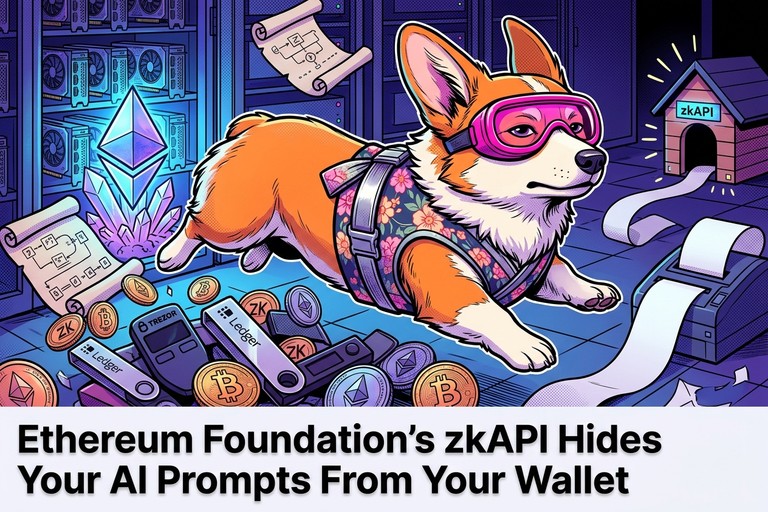
The Ethereum Foundation Wants Your AI Prompts to Stop Snitching on You
The Ethereum Foundation's dAI team shipped zkAPI, a system for paying for AI models and other metered services without the provider being able to trace usage back to a single payer. It's live on Ethereum mainnet, built with the Open Anonymity Project, and — per the project's own repo — described as "experimental."
How it works, roughly:
- You deposit ETH or USDC into a vault contract once; the balance sits as a private note on your device.
- Your machine generates a zero-knowledge proof that some funded, unspent note covers the cost, without revealing which one.
- A zkAPI server verifies the proof and issues a temporary API key with a dollar cap.
- Prompts go straight from your device to the AI provider; the balance is charged for actual usage when the key expires.
In the foundation's framing: "The server that handles money never sees content, and the provider that sees content never learns the billing identity behind a key." The client mimics OpenAI and Ollama interfaces locally, so existing apps can plug in. Leftover funds can be withdrawn onchain even if every zkAPI server goes dark.
"Experimental" is doing a lot of lifting in that announcement. Zero-knowledge payment rails for AI inference are genuinely interesting plumbing — and also exactly the kind of thing you don't want audited by vibes. The foundation is upfront that zkAPI does not provide network anonymity; providers still see request contents and metadata. It hides the payer, not the prompt.
BitGo's CEO Says the One-Stop-Shop Is a Lehman Waiting to Happen
BitGo (BTGO) CEO Mike Belshe told The Block at Korea Blockchain Week that the Senate's failure to advance the Clarity Act — rejected on a motion to proceed Sept. 15, short of 60 votes — left U.S. capital markets exposed to firms combining exchange, brokerage, and custody under one roof.
- Belshe's core worry: custody risk and counterparty credit risk.
- "Exchanges have never held custody, never, of anything," he said. "And they certainly didn't hold custody of the world's most dangerous asset, the bearer asset."
- He pointed to Coinbase (COIN), which recently added a derivatives clearing organization license on top of an existing futures commission merchant license and its exchange.
- His Lehman comparison: the 2008 failure was survivable because it wasn't the New York Stock Exchange. "Imagine if that had been the New York Stock Exchange offering those services and the whole New York Stock Exchange went down."
A custody exec arguing that custody should be more complicated and more regulated is not exactly a neutral observer. But "the entire market goes down" is a real sentence when one entity holds the keys, the order book, and the clearing license.
NEAR Intents Got Drained for $3.8M and Everyone's Calling It a Good Hack
NEAR Intents briefly shut down Thursday after an attacker took about $3.8 million, per Decrypt's Morning Minute. The flaw sat in the layer moving money in and out and how it talked to the main contract holding user funds. ZachXBT traced the funds to KuCoin, where they were converted to bitcoin.
- The contract-side hole is patched and core services returned within about an hour.
- Deposits and withdrawals on 11 networks — including BNB Chain, Polygon, and Optimism — stayed down another 12 hours.
- Every affected user gets paid back in full.
- NEAR fell nearly 9% to $4.86; the Bitwise NEAR ETF dropped more than 7% — two days after launch.
"Bullish hack" is a phrase that should not exist, and yet here we are. Fast patch, full reimbursement, no Kelp-DAO-scale cratering. The bar is on the floor and NEAR cleared it.
Arthur Hayes: Money Printing Is the AI Trade Now
At CONNECT by Cointelegraph: Seoul Edition, Maelstrom CIO Arthur Hayes argued AI companies need trillions for data centers even as their service prices fall — leaving policymakers few options besides printing. "They've not really given themselves a lot of options other than print money and make it less bad," he said, also flagging a possible China shift from "austerity lite" to real stimulus, and watching French credit stress.
Elsewhere on the panel circuit, Portal Ventures' Catrina Wang made the aggregation-theory case for Wall Street onchain: "Whoever owns the customer relationship owns the economics." R3 co-founder Todd McDonald noted public blockchains offer access to customers outside incumbent walls.
"Print money to fund AI" is a thesis with a lot of moving parts and one reliable output: more liquidity looking for scarce assets. Whether that lands in bitcoin or in a data-center REIT is the part nobody's modeling.
Odds and Ends
- Tokenized stocks and ETFs crossed $3.7 billion in market cap, with BNB Chain the first chain past $1 billion (about 30% share), ahead of Ethereum at $828M and Solana at $738M, per Token Terminal. BNB Chain also leads with 1.8 million addresses holding tokenized stocks.
- The SEC proposed a tailored custody framework letting advisers and funds hold crypto, including conditional self-custody and state trust companies as custodians.
- Evernorth, the Ripple-backed XRP treasury, cleared its SPAC shareholder vote and heads to Nasdaq under ticker XRPN on Oct. 8, expecting to hold roughly 473 million XRP.
- Bitcoin pushed toward $87,000, with short liquidations topping $120 million in 24 hours; Citi raised its 12-month BTC target to $113,000.
- Tether's USDT is set to return to Bitcoin via Tether-backed Utexo, keeping most transaction data off the public ledger.
- Spanish police arrested a 16-year-old suspected of running the KillSec ransomware group, with Europol seizing servers and at least 110 TB of stolen data.
Closing Take
The AI-crypto story this week isn't another token — it's plumbing. The Ethereum Foundation is trying to make inference payments private, BitGo is arguing that custody and exchanges shouldn't share a roof, and NEAR is proving that "we patched it fast" is now a marketing position. None of it is hype-proof, but at least it's about infrastructure instead of a ticker.
Not financial advice. Side-Eye Signals reports what sources say, not what you should buy.
Social Pulse
Social chatter is thin and mostly onchain-watcher territory: one wallet-tracking account is flagging a fund's HYPE round-trip, which reads more as opportunistic dip-buying than conviction. No broader AI-crypto sentiment signal worth amplifying.
- @lookonchain — Flags that Maven 11 sold 115,000 HYPE at an average of $93.84 a week ago and bought back 40,000 HYPE at $89 today — a partial round-trip that looks more like dip-scooping than a clean exit. (source)