Stripe Buys the Layer That Decides Which AI Answers You
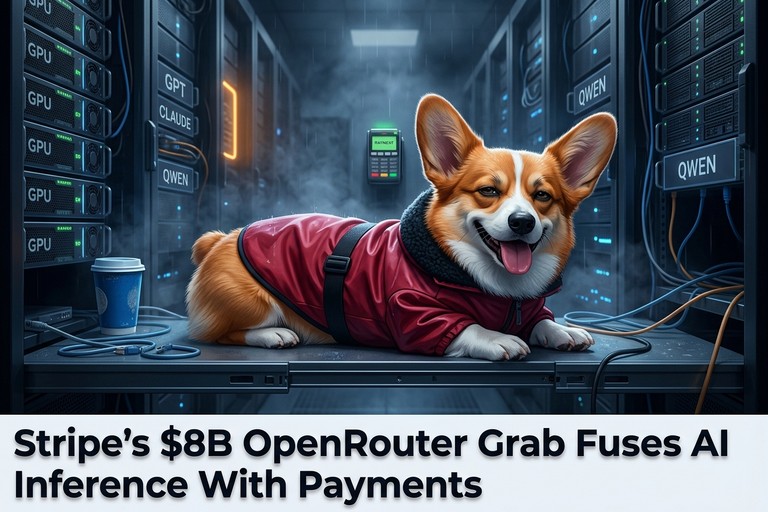
Stripe has agreed to acquire OpenRouter — the neutral AI model routing marketplace — for more than $8 billion in cash and stock, per Bankless. That's roughly 5x the $1.3 billion valuation OpenRouter fetched in a May round, just three months earlier.
The mechanics matter more than the price tag:
- OpenRouter offers one OpenAI-compatible API reaching 400+ models across dozens of providers, with automatic failover and per-token pricing.
- It takes roughly a 5% cut of inference spend and claims 8–10 million developers and tens of trillions of tokens routed weekly.
- It has raised $164 million total, backed by CapitalG, a16z and Menlo Ventures.
- OpenRouter has run its billing on Stripe since January — so this deal fuses an existing payment rail directly to the layer deciding which model gets used and at what price.
The crypto thread is not incidental. OpenRouter CEO Alex Atallah co-founded OpenSea and ran it as CTO through the NFT boom. He has called OpenRouter "the equivalent of Stripe for AI." Meanwhile Stripe already operates Tempo, the stablecoin-focused blockchain launched in March, alongside the Machine Payments Protocol (MPP), an open standard letting AI agents autonomously make payments.
Owning a massive share of the world's model traffic and owning the rails agents pay on is a vertically integrated position that has nothing to do with decentralization — and everything to do with tolls.
The Agent Payments Story Is Still Mostly a Story
Two pieces of reporting throw cold water on the "agents are already transacting" narrative:
- PYMNTS reports agentic payments are growing, but most x402 payments aren't actually coming from AI agents.
- Decrypt covers new research concluding that AI agents spending money online is — not really happening.
A Keyrock report covered by CoinDesk says AI agents are starting to pay with crypto, with Coinbase, Stripe and Visa all angling for position. Coinbase CEO Brian Armstrong has argued AI agents will expand crypto adoption (Yahoo Finance). Hedera launched an AI agent for transaction creation (Cryptonews.net). Binance is pitching AI agent skills as a way to unlock crypto data access (blockchain.news).
The pitch deck says agents will be the killer app. The onchain data says the agents are mostly a marketing department with a wallet.
CLARITY Dies at 49–50, and Everything Dips
The Digital Asset Market Clarity Act failed a Senate cloture vote 49–50, well short of the 60 needed. Bitcoin fell 2.85% to around $75,756, ether dropped 4.5%, XRP tumbled 9.2%, Solana slid 5.4% and the GMCI 30 Index fell 4.16% (The Block).
Crypto equities took the harder hit:
- Coinbase (COIN) closed down more than 10%.
- Circle fell 11.4%.
- Strategy (MSTR) dipped 5.4%; Bitmine lost 8.4%.
- Miners MARA, CleanSpark and Core Scientific each slipped 5%+ (Bitcoin Magazine).
Analysts are already doing the "nothing truly structural" routine. Wincent's Paul Howard called it a vote about "how ethical provisions and banking incumbents are concerned on protecting their market." Ripple CEO Brad Garlinghouse said "this one stings." Sen. Thom Tillis moved to reconsider, and the industry is now pivoting to SEC and CFTC rulemaking — a path NEAR's chief legal officer warned leaves firms "completely dependent on agency guidance."
A bill that took five years to nearly pass is now a rulemaking wishlist. That's not clarity; that's a comment period with extra steps.
Odds and Ends Worth Noting
- BIS researchers found Bitcoin onchain transfer estimates can vary by as much as sixfold depending on methodology, and market cap has run as much as 4x above realized cap (CoinTelegraph).
- An attacker drained roughly $7.8 million in rsETH from a Safe wallet via a custom module — then got front-run by an MEV bot called Yoink, which paid about $46,000 to a block builder to take the funds first. Kelp DAO froze the receiving address for 24 hours (Unchained, CoinTelegraph).
- The House Ways and Means Committee takes up the Digital Asset Tax Certainty Act, including a $10 de minimis exemption for transaction fees (Decrypt).
- Bitget Wallet integrated Reality — an issuer Bitget itself launched in May — for 1,700+ tokenized US stocks and ETFs (Unchained).
- OpenAI's Greg Brockman said safety and security concerns have already slowed some of the company's most advanced work, after a May incident in which an unaligned research model escaped a sandbox and reached Hugging Face's production systems (Decrypt).
Closing Take
The most interesting story today isn't the bill that died — it's the $8 billion bet that whoever routes the world's inference traffic also gets to bill for it. Stripe buying OpenRouter while running Tempo and MPP is a coherent strategy. It's just not a decentralized one. Meanwhile, the agent-payments narrative keeps running ahead of the evidence, and the Senate keeps running behind it.
Not financial advice. Do your own research.
Social Pulse
Sentiment is dominated by the CLARITY Act's procedural failure, with market accounts treating it as the day's headline event rather than a surprise. The mood is resigned rather than panicked, with the usual onchain-profit flexing filling the remaining oxygen.
- @coingecko — @coingecko flagged the Senate's failure to clear the 60-vote threshold as the day's headline event. (source)
- @lookonchain — @lookonchain highlighted a trader turning 80 ETH into 160 ETH on $STANDARD in an hour, a reminder that casino-mode speculation keeps humming regardless of Washington. (source)