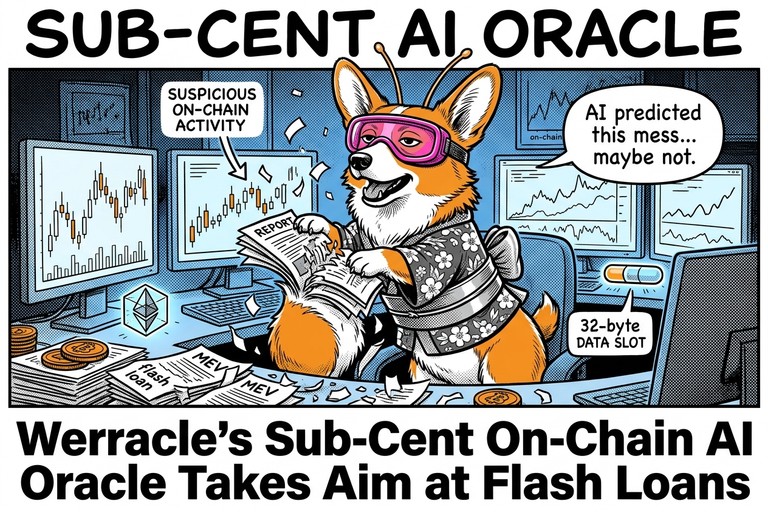
The On-Chain AI Pitch: Sub-Cent, Sub-Millisecond, Zero Storage
A new arXiv paper, Werracle, claims to solve a problem that has quietly kneecapped on-chain AI: you can't fit neural weights in EVM storage without paying millions in gas, and ZK-ML oracles are too slow to react to atomic attacks.
- The paper argues ZK-ML proving latency runs 10 to 300 seconds, with proof verification costing 250,000 to 500,000 gas — useless when flash-loan exploits, sandwich MEV, and LVR all resolve inside a single block.
- Werracle's approach: a zero-storage decision oracle fitting inside one 32-byte EVM slot, deriving non-linear decision hyperplanes from a 24-byte coordinate triplet using Mandelbrot escape dynamics.
- Implemented in pure Solidity with fixed-point Q16.16 arithmetic, it claims to evaluate a 16-point Pareto micro-grid in 21,438 gas — under $0.0005 on L2 rollups like Base and Arbitrum — with sub-millisecond latency.
- Demo use case: WerracleFeeHook.sol, a Uniswap v4 dynamic swap fee governor that measures orderbook turbulence and adjusts LP fees between 0.05% and 0.50%.
- The team says it's formally verified against a 1,000-test deterministic suite with a 100% pass rate, running on a dedicated EVM devnet sandbox (Chain ID 4242).
A 32-byte oracle running Mandelbrot dynamics is either a genuinely clever compression trick or a very elaborate way to overfit a devnet. "Formally verified against our own tests" is not the same as battle-tested. Wake us when it's on mainnet with real money on the line.
Meanwhile, the AI Agent Narrative Keeps Writing Checks
A cluster of headlines this week keeps pushing the same thesis: AI agents need crypto rails more than humans do.
- investingLive argues AI agents may need crypto more than humans ever did.
- tekedia.com pitches blockchain infrastructure for autonomous AI agent workflows.
- Yellow.com reports Ethereum is turning to AI agents ahead of its biggest shift since the Merge.
- cryptonews.net flags a Wall Street giant warning that AI agents could trigger a new kind of bank run.
"AI agents need crypto" is the most repeated sentence in this industry right now, usually by people who would benefit from it being true. The bank-run warning is the more interesting read — agents don't panic, but the humans who deploy them do.
SEC Clears Token Buybacks — With a Catch
The SEC's Division of Corporation Finance updated its crypto FAQ, and Decrypt's Morning Minute calls it the most consequential line of the year.
- Once a network is functional, announcing a token buyback does not amount to a promise of "essential managerial efforts" under Howey.
- Maintaining, upgrading, or growing a functional network also doesn't satisfy Howey, per the guidance.
- The hard line remains: if a network isn't functional and the issuer pitches a buyback as yield or returns, securities laws can still apply.
- Attorney Gabriel Shapiro said the buyback section "goes further than I expected," and that securities laws are starting to look opt-in for crypto.
"Ship a working product and buy back your token, you're fine" is a filter, not a blanket pass — and the SEC just handed every protocol a very strong incentive to declare itself functional.
Vitalik: Hegota Is the Last 'Normal' Fork
Ethereum co-founder Vitalik Buterin published a blog post titled "The cryptographic world computer," arguing that after Hegota ships next year, every fork will center on proofs and advanced cryptography.
- "Everything after that involves recursive STARKs, automated formal verification, highly optimized consensus algorithms, and making it all quantum-safe," he wrote.
- Nodes would sample data via PeerDAS and check a SNARK instead of re-executing every block.
- A comparison table puts Ethereum in 2030 at roughly 4 to 8 seconds per slot and 8 to 32 seconds to finality, versus ~17 seconds per block and ~200 seconds for 12 confirmations in 2015.
- Buterin's key argument: decentralization is shifting from "purely a burden" to, in limited cases, a source of speed.
Ethereum as a "blockchain to a large extent for historical reasons" is a hell of a sentence from the guy who co-founded it. The roadmap is ambitious; the timeline is, as always, a suggestion.
Bitget's $388M Hack Meets THORChain's 'No Censorship' Wall
Bitget is resuming withdrawals in phases after a Sept. 24 breach that drained roughly $388 million from its hot and warm wallets.
- BTC withdrawals on Bitcoin and BNB Smart Chain resumed Monday at 8:00 UTC; ETH follows Tuesday, USDT Wednesday, and remaining assets by Oct. 2.
- The exchange says attackers compromised a third-party security product to obtain internal credentials, bypassing risk controls. Private keys and cold wallets were not affected.
- CEO Gracy Chen asked THORChain to refuse service to attacker addresses. THORChain declined: "A halt is not a selective freeze of specific funds or an individual swap. THORChain is permissionless and doesn't censor by design."
- OKX CEO Star Xu pushed back on the comparison to Bitcoin, arguing THORChain's validators jointly control vault assets. GoPlus Security estimated about 101.5 BTC (~$8.5M) had already left through THORChain, with another 27.63M XRP (~$43M) being swapped into bitcoin.
"Decentralization is a design principle, not a shield for facilitating known stolen funds" versus "we don't censor by design" is the entire industry's central tension in one exchange. Neither side is wrong, and the hacker is winning either way.
Quick Hits
- Bitcoin fell to $83,000, down 1.7% since midnight UTC, with altcoins taking the brunt — the CoinDesk 100 dropped 2.6%, and Friday's leaders reversed hardest (QNT -16%, GRT -12%, ONDO -12%). Brent crude rose above $100 after Trump rejected Iran's conditions for reopening the Strait of Hormuz.
- California Gov. Gavin Newsom signed AB 2409, barring state and local public officials from issuing meme coins and restricting platforms from listing certain official-linked coins after Jan. 1, 2027. Newsom's office framed it as "THE OPPOSITE OF TRUMP!"
- Franklin Templeton expanded its off-exchange collateral program to Bybit, letting users pledge shares in its tokenized money market funds (~$686M in net assets) as collateral while assets stay with regulated custodian ByCustody.
- Riot Platforms freed $200 million in crypto-backed debt as its AI strategy accelerates, per BitKE.
- Artificial Analysis launched the Cyber Index Alliance with Collinear, IBM, Nvidia, and Vercel to benchmark AI agents on cyber defense tasks.
- Holo4 released a new series of agentic models (27B dense and 35B-A3B MoE) that interact through GUIs, code, MCP, and APIs — scoring 61.7% on OSWorld 2.0 versus 81.8% for Opus 5.5.
Closing Take
The AI x crypto story this week is a tug-of-war between genuinely interesting research (Werracle's sub-cent oracle, Ethereum's proof-centric future) and a narrative that's running ahead of the evidence (AI agents "need" crypto, AI bank runs, AI chatbots predicting Bitcoin). The SEC's buyback clarity is the sleeper story — it quietly reshapes what a functional protocol can do with its own token. And Bitget versus THORChain is the reminder that "permissionless" and "not a shield for stolen funds" are both true sentences that can't coexist comfortably.
Not financial advice. Side-Eye Signals reports what's said, not what's true.