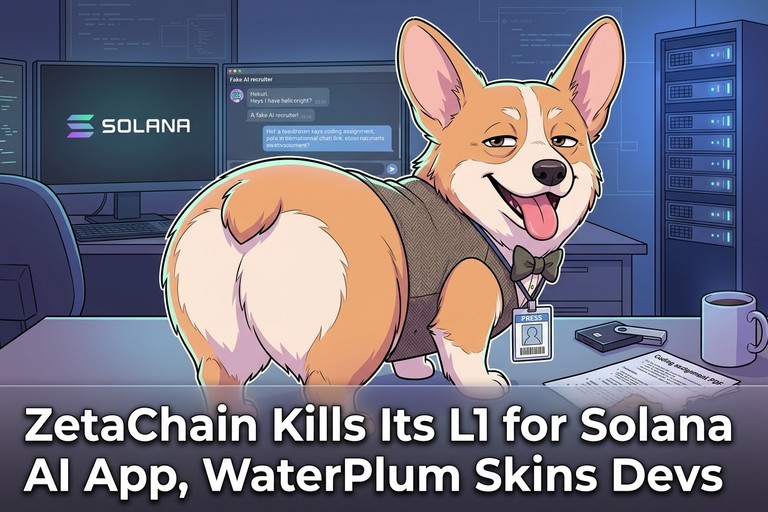
ZetaChain Votes Itself Out of Existence, Blames AI Tooling
ZetaChain's token holders approved Proposal 68 with 99.4% in favor at 10:58 a.m. ET Sunday, per The Block, voting to shut down the project's Layer 1 blockchain and migrate the ZETA token to Solana as a native SPL token. Participation hit 58%, clearing the 40% quorum. Opposition and abstentions were 0.3% apiece.
The project raised $27 million three years ago to connect competing networks. Now its contributors are working on Anuma, an AI app launched in February with self-reported 300,000+ users and a million requests across 35 AI models. The team's pitch: an encrypted memory system that travels across models, apps, and agents — and ZETA holders can lock tokens for credits to spend on AI.
- The migration proposal cites the maintenance burden of a Cosmos SDK chain: "every upstream advisory and patch... has to be coordinated across dozens of independent validators."
- It explicitly points to AI tooling making vulnerabilities easier to find, referencing an August 25 patch, and warns "there will be more."
- Last month Cosmos Labs disclosed attacks against six Cosmos EVM chains (not ZetaChain); attackers sold stolen funds for about $5.7 million.
- No shutdown date yet — the chain keeps running while conversion details get worked out.
Nothing says "we believe in our own chain" like a 99.4% vote to leave it. The tell is the rationale: the team isn't migrating for users, it's migrating because AI-assisted bug hunting makes running a small Cosmos chain an expensive liability. "What Solana's AI stack still lacks is the application layer" is a fine pitch, but it's also a confession that the L1 was never the product.
North Korean Fake Recruiters Bait AI and Crypto Devs
A joint advisory from Japan, Germany, Australia, and the US ties North Korean group WaterPlum (aka Contagious Interview) to at least $10.7 million stolen by impersonating recruiters at legitimate AI, crypto, and NFT companies. The targets: web designers, engineers, and specialists in crypto, blockchain, and Web3.
- The group infected at least 30,000 devices across more than 100 countries.
- Funds or credentials were extracted from over 7,000 cryptocurrency wallets between December 2025 and July 2026.
- Lures came via social media, job platforms, gig sites, and freelance marketplaces; victims downloaded "coding assignments" or fake video-conferencing fixes that were actually malware.
- Backdoors enabled remote-access trojans and infostealers, and opened paths into the employers of the infected developers.
- The advisory links WaterPlum to North Korea's broader IT-worker infiltration campaign under the Munitions Industry Department.
The punchline writes itself: the job listing was fake, the company was fake, the take-home assignment was malware, and the only thing actually hiring was the exfiltration script. If an "AI startup recruiter" DMs you a zip file, that's not a red flag, that's the whole parade.
Meanwhile, the AI Agent Payments Thesis Gets a Reality Check
TRM Labs analyzed x402 and put actual AI agent payment demand at below 10%, according to finance.biggo.com. That's a useful cold shower for a narrative that Coinbase CEO Brian Armstrong has been pushing — he's argued AI agents will expand crypto adoption (via The Motley Fool), and Jordi Visser went further, claiming crypto was built for AI agents and the breakout has "already started" (finance.biggo.com).
Over on the token-marketing beat, the VIRTUAL token is being framed as the top AI token on Robinhood Chain (Bitcoin Foundation), and a presale piece touts MemeToro's "AI utility" (Crypto News). We'll note both exist. That's the level of endorsement they've earned.
"AI agents will drive crypto adoption" and "actual agent payment demand is under 10%" can both be true — that's what a thesis looks like before it's a market. The gap between the two is where most AI tokens live, rent-free, forever.
The AI Side: Chips, Pacing, and a Whole Lot of Safety Paperwork
- OpenAI and Broadcom unveiled Jalapeño, a custom chip built for LLM inference, aimed at performance, efficiency, and scale.
- Sam Altman confirmed OpenAI won't go public this year, telling Fortune via Techmeme that "given everything happening with safety, right now would be an ill-advised moment to go public." He also said he agrees with Dario Amodei that independent evaluators with employee-like access is "a great idea," and that OpenAI will do the same.
- Altman added that OpenAI "welcome[s] a federal framework" but "do[es] not believe we need to wait" for an antitrust exemption or a law to pace AI development responsibly.
- AI-connected Asian stocks fell sharply after US tech leaders called for pacing AI development, with SoftBank, Kioxia, SK Hynix, Minimax, and Z.ai down 5%+ (Reuters via Techmeme). Separately, SoftBank sealed a two-year loan facility for its OpenAI investment, securing $11.87 billion in commitments from ~20 banks, above its $10 billion target (Bloomberg via Techmeme).
- Google DeepMind expanded its partnership with the UK AI Security Institute via a new MoU on foundational security and safety research.
- On the open-model front: Gemma Scope 2, described as the largest open-source interpretability release by an AI lab to date (~110 petabytes stored, 1 trillion+ parameters trained), and Gemma 4 12B, a unified encoder-free multimodal model that runs locally on 16GB of VRAM. Hugging Face also published retrospectives on China's open-source ecosystem one year after the DeepSeek moment, and on agentic RL training for GPT-OSS.
- AssetOpsBench from IBM Research targets agentic AI evaluation in industrial asset management: 2.3M sensor telemetry points, 140+ scenarios, 4.2K work orders, 53 failure modes.
The frontier labs spent the week promising independent evaluators, federal frameworks, and safety-first pacing — right up until the moment it might cost them something. Altman's "we don't need to wait" is the most honest sentence in the entire genre.
Policy Corner: CLARITY Dies, Saylor Shrugs
- The Senate failed a cloture motion on the Digital Asset Market Clarity (CLARITY) Act, 49–50, well short of the 60 needed. Sen. Thom Tillis confirmed he switched his vote at the last minute to preserve the ability to call a new vote.
- Congressman Shri Thanedar told CoinTelegraph Magazine the timeline is a "major barrier," citing only 20 legislative days left in this Congress, all after the midterms.
- Two days after the failure, the SEC announced a five-year exemption allowing limited trading of tokenized US stocks on decentralized public venues.
- Michael Saylor argued the collapse is a win, writing on X that legislation "can make restrictions permanent just as easily as rights," and urging regulators to let the industry "innovate rapidly in a free market."
Saylor calling a legislative failure a win is on brand, but the more interesting detail is the SEC filling the vacuum with a five-year exemption while Congress argues about whether to have an opinion. Rulemaking by agency is now the de facto crypto policy of the United States. Enjoy the whiplash.
Closing Take
ZetaChain's 99.4% self-deletion vote, WaterPlum's fake AI recruiters, and TRM's sub-10% agent payment estimate are three views of the same thing: the AI-crypto story is real enough to move tokens and attract criminals, and not yet real enough to survive an honest demand check. Builders are migrating chains to chase it, nation-states are weaponizing the job listings around it, and the actual usage numbers remain a rounding error. That's not a reason to dismiss the sector — it's a reason to stop pricing it like it already won.
Not financial advice. Side-Eye Signals reports what sources say, not what tokens deserve.